Guides / Materials
Keep your filament dry: the cheap fix for stringy prints
Popping sounds, strings and rough surfaces are often wet filament, not bad settings. How to tell, how to store spools properly, and how to rescue a damp one.
Plastic filament absorbs water from the air. You cannot see it and the spool does not feel wet, but inside the hot nozzle that water turns to steam. The result looks exactly like a settings problem, which is why so many people spend a weekend tuning retraction when the real fix is a sealed box.
How to tell
- Sound: small pops or a faint crackle as the filament comes out.
- Strings: fine hairs between parts that stay no matter how you set retraction.
- Surface: rough, matte or bubbly walls on a filament that used to print glossy and smooth.
- Strength: layers that split apart more easily than they should.
A quick test: extrude 10 cm into the air and look at it. Dry filament comes out smooth and clear. Wet filament comes out with tiny bubbles and an uneven thickness.
Which materials mind most
| Material | How fast it absorbs water | What happens when damp |
|---|---|---|
| PLA | Slowly | Stringing, brittle filament that snaps on the spool |
| PETG | Moderately | Heavy stringing, blobs, hazy surface |
| TPU | Quickly | Bubbles, very rough surface, weak parts |
| Nylon | Very quickly | Can be unprintable after a day in open air |
| ABS / ASA | Moderately | Rough surface, weaker layer bonding |
Storage that works
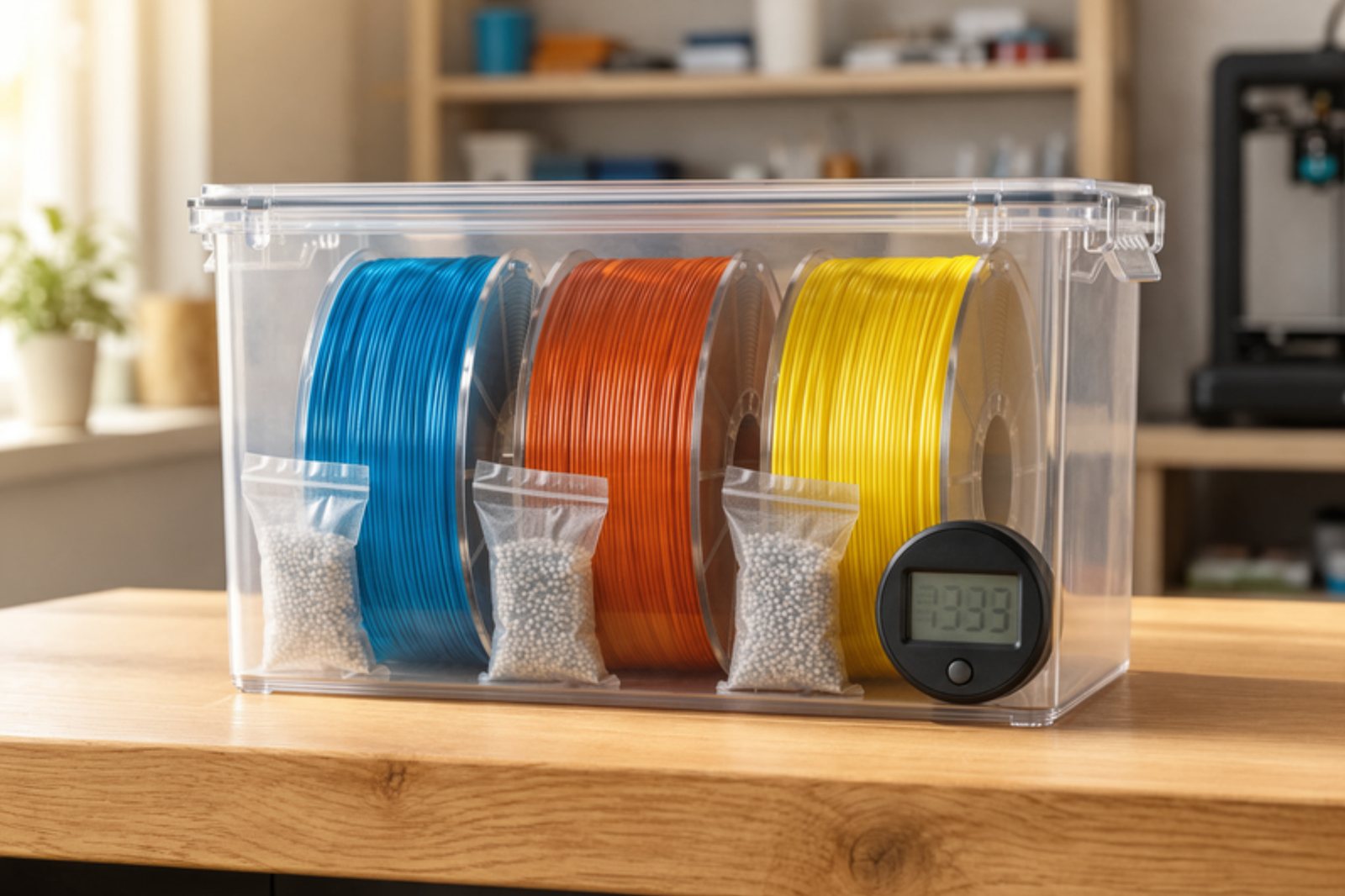
- An airtight container. A gasketed storage tub, a cereal container for a single spool, or a zip bag made for filament.
- Desiccant. Silica gel is cheap and reusable. Colour-changing beads show you when they are spent.
- A humidity gauge. A small digital one costs very little and takes the guessing out of it.
- Put spools away. A spool left on the printer for three weeks is being stored in open air.
For thirsty materials such as Nylon and TPU, print straight from the dry box through a short tube so the filament never sits in room air.
If you are tuning retraction for the third evening in a row, stop and dry the spool.
Rescue a damp spool
Gentle heat for a few hours drives the water back out. These are typical starting points; the filament maker's own guidance always wins.
| Material | Typical drying temperature | Typical time |
|---|---|---|
| PLA | 45 to 50 °C | 4 to 6 hours |
| PETG | about 65 °C | 4 to 6 hours |
| TPU | 50 to 55 °C | 4 to 6 hours |
| ABS / ASA | about 80 °C | 4 to 6 hours |
| Nylon | 70 to 80 °C | 8 to 12 hours |
Know what you have, and how old it is
The spool that causes trouble is usually the half-used one that sat open at the back of the shelf. SpoolBoss keeps the date you bought each spool and how much is left, so you can see at a glance which rolls are oldest and use them first. Scan or forward a receipt and new spools are added for you.
Common questions
How do I know if my filament is wet?
Listen and look. Wet filament pops or crackles at the nozzle, leaves fine strings between parts that retraction does not fix, and gives a rough or bubbly surface on a spool that used to print cleanly.
How should I store 3D printer filament?
In an airtight box or bag with desiccant, ideally with a small humidity gauge inside. Aim to keep the humidity in the box low, and refresh the desiccant when the gauge starts to climb.
Can I dry filament in an oven?
It is risky. Many home ovens overshoot badly at low settings and can soften the filament or the spool. A filament dryer or a food dehydrator holds a low temperature far more reliably.